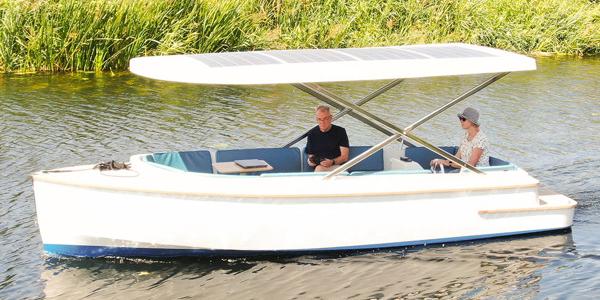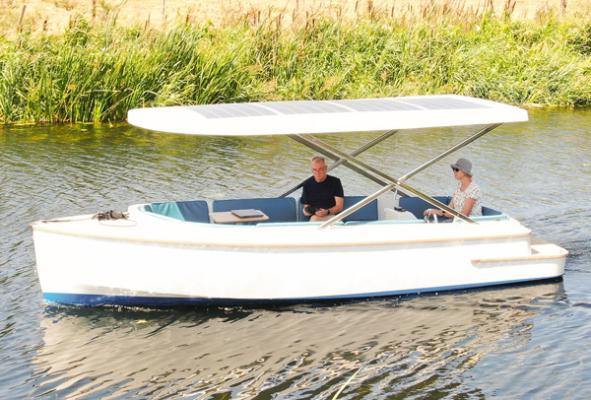
Tim and Sue Knox travelled 124 miles along the Thames relying entirely on the sun.
The Torkmar DB1 was built around a fully integrated zero-emission powertrain, engineered specifically for low-speed, high-torque displacement performance along inland waterways. By pairing optimized electrical componentry with high-yield solar collection, the DB1 operates as a self-sustaining platform for day-cruising without reliance on shore power.
A Nervous Start
It was a Tuesday morning. Drought conditions meant lock restrictions from Lechlade to Oxford. Locks could only run on the hour and half hour, and only between 9.30am and 6pm. Doubters said five days was impossible. Tim and Sue set off anyway. The first lock didn’t open until 9.30am sharp. The water levels, though, were healthy. Careful management by the Environment Agency was paying off.
Clearing the Weed
Early stretches of the river are choked with weed. It can quickly foul a propeller. Last year, that meant diving in to clear it by hand. This year, DB1 had a weed hatch built into the hull over the winter. Clearing the prop now took under a minute.
Managing Power Under Pressure
Cruising gently, DB1 drew about 0.25kW and moved at 3.5 to 3.8 miles an hour, depending on headwind. Rushing for a lock changed that fast. At 0.5kW, speed rose to 4.2–4.5mph, but consumption doubled. The solar array was producing around 350 watts when the sun was higher in the sky. By evening on day one, the 5kWh lithium battery bank sat at 73% state of charge. That meant just 1.5kWh had been used to cover nearly 30 miles. One lock short of Oxford.
Day Two: Filming with Cruising the Cut
Day two began at Godstow Lock and rolled into Oxford, past the college spires. YouTuber David Johns, from Cruising the Cut, joined for filming.
Careful cruising overnight and through the morning pushed the state of charge from 73% to 75%. South of Oxford, Tim opened the throttle to 0.6kW to make a restricted lock on time. DB1 hit 4.8mph, handling smoothly with very low motor noise and barely any wash. Half an hour of hard cruising cost 6% of charge. The day ended at Shillingford, in time to watch a partial solar eclipse from the water.
Day Three: A Broken Lock
Day three started at 75% charge. The trip continued smoothly through Wallingford and Goring, then Whitchurch Lock failed. Debris had jammed the gates, and only a length of pole and patience could clear it. The fix took well over two hours. Lost time meant a rush to Henley. With restrictions lifted for the evening, DB1 pushed on into the evening, arriving to see Henley’s riverside social scene in full swing. SOC on arrival 60%.
Day Four: Windsor and a Drone Mishap
No lock restrictions ahead. That gave Tim room to cruise gently and watch the world go by: rowers training out of Henley, Temple Island, and the grand houses of the Thames Valley. A drone launch near Marlow went wrong. The heat really effected the controls and lead to an emergency landing in a field across the river. The day finished at Windsor, past the castle and a stretch of houseboats, each one different from the next. SOC 69%.
Day Five: The Final Stretch
The last day. More restrictions lay ahead between Eton and Teddington. The route passed behind Windsor Castle, Magna Carta Island, and on through Staines and Weybridge. Business partner Iain Sommerville joined along the way, along with family. At Teddington Lock, the trip closed on a high tide, with water pushing into the non-tidal Thames. Five days, planned and delivered, entirely on solar power. Final SOC 70%.
The Numbers
- Route: Lechlade to Teddington, 124 Miles
- Duration: 5 days
- Power source: Solar only, no generator, no shore power
- Battery: 5kWh lithium bank
- Cruising draw: 0.25kW at 3.5–3.8mph; 0.5–0.6kW at 4.2–4.8mph
- Solar input: Approx. 350W around midday
- Total consumption: 1.5kW
Proof on the Water
Drought, broken locks, and tight restrictions could have ended this trip early. Careful power management, a well-built weed hatch, and a battery bank that recovered daily on sunlight alone kept DB1 moving. It stands as a working example of what a solar electric dayboat can do on a real river, under real pressure, across five demanding days.